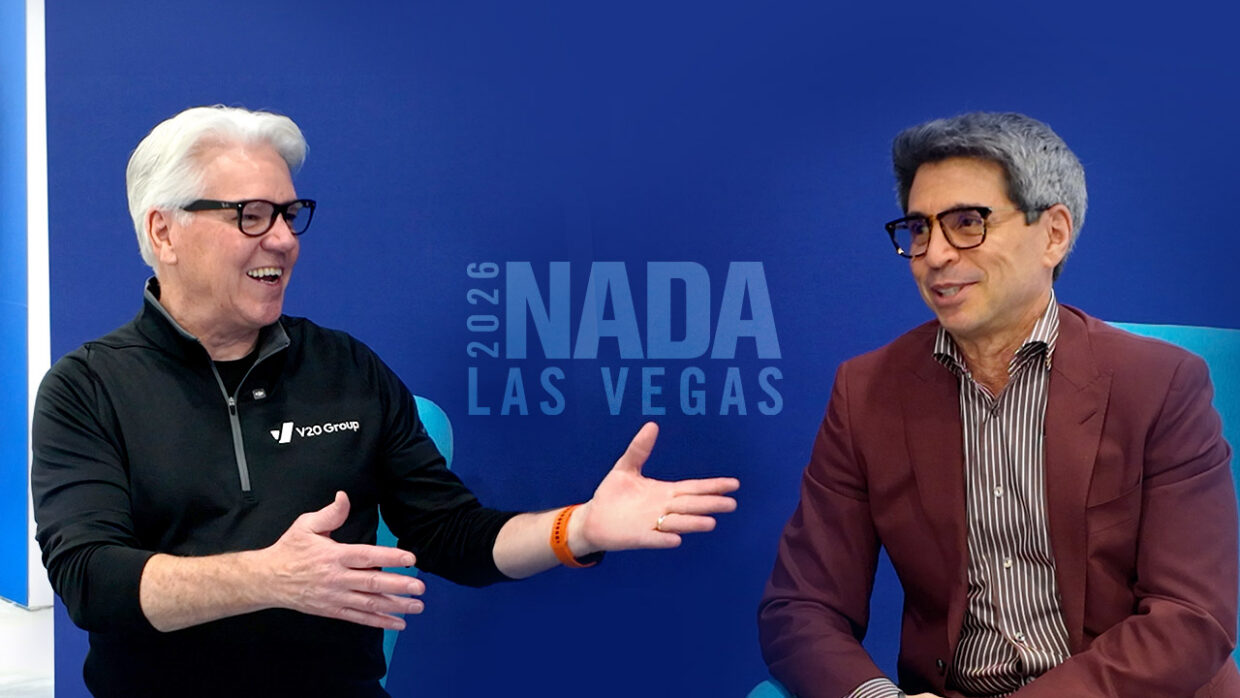
In this fireside chat, ActivEngage CEO Ted Rubin and industry leader and V20 Group founder David Kain discuss the most productive ways to use AI in automotive retail.
The focus is simple:
AI should support and enhance dealership teams, not replace sales conversations.
In this discussion, you’ll learn:
- Why the first customer conversation should stay human
- The difference between customer service automation and sales engagement
- How AI can improve dealership performance without removing accountability
- Why human connection still drives appointments and vehicle sales
Ted introduces the new ActivEngage AI Suite, designed specifically for automotive dealerships:
AI Receptionist – Answers questions and routes customers to live agents
AI Conversation Summaries – Highlights key details for faster follow-up
AI tools built to enhance live chat, text messaging, and dealership communication
Unlike fully automated messaging tools, the ActivEngage AI Suite is built around a human-centric engagement model. The goal is to increase appointments, improve response time, and support dealership sales teams, not replace them.
The full transcript is available below for reference.
Well, it's always exciting for me when I get to visit my long-term friends and I'm at the ActivEngage Booth today having a fireside chat. With my friend Ted Rubin. And Ted I was complimenting you on your outfit earlier and I was saying how nice it is to walk into a booth and you're not wearing the blues or the grays and stuff.
You've always inspired me with the way you dress. So first let's have a little fun with the audience. What gives with this cool color today? Hey, man, I just wanted to ask something that was kind of, you know, a little bit more fun and interesting. You know, I, I. I feel compelled to every year I kind of spruce it up a little bit.
Yeah. I like to kind of look good for the customers and for everybody walking by, so I feel like it's important. It's a brand almost at this point, right? So no question. Well, you know, I'm trying hard, I'm trying, working for everybody out there. By wearing this stuff. Well, we will, we'll start to build a following to watch what friend what there you go.
You're gonna be wearing and all your friends are gonna be paying attention. I got Jeff over there, a DealerAlchemist who's already, you know, like trying to keep up and like that's good. So as you and I both have, RA been raised and spent so much time in automotive retail and I think it's important, we appreciate the challenges.
That comes with this. If you think back to early days automotive retail, you were involved with technology way back then. You invented, you know, built some of the early CRMs Right? And such dealers benefited from it. And I think that's always been a core tenant of your development of things. Yeah.
So here's where I'm, here's where I'm going with this ActivEngage. What I've always said to my clients is. It's human centric, it's driven by humans. When you reach out and you are chatting with them, it's a human that, you know, if you told 'em, hold it, I've gotta be right back, they'd say, I understand.
But in this era of AI, you've had to adapt. And I would just be curious, what was your motivation for the AI suite and obviously. It's important for you to retain that human-centric connection. Yeah, absolutely. I, you know, our entire intention always is to be human-centric, not just with our agents, but around the dealership and, you know, driving people to, driving customers to the people at the store.
'cause that's what needs to happen. That's the goal. And so I think that gets lost sometimes with some people when they start thinking about technology. I think all the way back to, you know, when I got started in the industry, it was like websites and it's like, oh, I just have to have one. It doesn't matter what it says, you know?
And it's just, I just have to have something. Yeah. And I think that we're living that, or we have lived that for a few years here, where they're like, oh, ai, that's the new website. Yeah. And people are just like, I gotta have, it doesn't matter what it does, I just have it. And there was the promise of all these things.
And now we're starting to see kind of the shakeout of what it really can do and can't do. And I think what's important to understand is that there are some massive value and some big assets that AI brings. Yes. You know, to the industry and to the way that you would run your dealership, and that it would guide your dealership.
But at the same time, I would also caution people. That, you know, people need to stay in control of it. Yes. And people need to be the decision makers, whereas AI should be making the suggestions. Okay. So AI can look at things very broadly and take a lot of information, a lot of information, and kind of find very.
Analytics and articulate things that would be very hard for individuals to find better significant as far as the value to the way that you would run or operate your business. Yeah. Yeah. And that's what it should be used for. But I think that there should always be this sort of overriding or oversight of humans, you know, that are there to make final decisions or to assess what it's actually doing.
So. When it comes down to what we do right with communications, it's hard to just have something to talk and then have like a live person who's just watching it and saying, oh, is this okay? Is it all going okay? Yeah. And so that's not what a lot of people are using it for, you know, they're just going, look, I feel like you know, I'm gonna have AI do it.
Either because you know, they, it's on all the time or it can handle a lot of conversations. Or for some reason they think that it's gonna be less expensive. And I think we've seen a lot of this, you know, over the past three years where people have a perception of it, and now they're coming to the realities of what it is capable of doing or not doing.
So. We, you know, obviously started looking at this a long time ago, you know, many years ago. You shared that with me. Yeah. As far as what we wanted to do with AI and how we were gonna leverage it. And so we started developing with it and trying to figure out, you know, how do we get the most out of this type of new tool?
Because we could see it was gonna be a big value for the Yeah, for our area of the industry and for the industry in general. But, you know, I don't wanna test it on dealers. I wanna make sure that we know what we're doing with it. And so our perception of this is something that. Ultimately, you know, was this human centric design and it's interesting.
So I don't know that we would've used that term before, but as we kind of came into looking at leveraging ai Yeah. That we saw that Harvard School of Business and John Hopkins Business School of Communications, that they both put together this idea of human-centric design, HCD. Yeah. I love it. And so the idea of that is.
How do you leverage AI, this technology to be focused on improving the way that humans get their benefit from that service? Sure. Okay. So it's not just, let's have the technology because it's the newest thing. It's, well, what can it really do to improve my life? What can it really do to improve the benefit of what I'm trying to use it to do?
And so our focus is around that. So we kind of locked in on that really before that came about. But as that came about, we started looking at the tenants of what that was, and we started to say, look let's make sure that any way that we're gonna deploy ai. For our tools, it's gonna have the highest level of production, it's gonna give the most value to our customers, the people in the store and their customers.
'cause that's who we're talking to, which are the end customers who are being spoken to and who are ultimately gonna buy cars. So how do you motivate these customers leveraging this tool? Is there something you can use it for that will drive them more impactfully toward the store for sale? Yeah, because that's the thing to remember is, you know, we're doing all of this to sell cars.
We're not doing this of course, 'cause we like the technology. We're not doing this just because we're trying to employ people and or anywhere in between. The singular focus is, how do I. Sell more cars and maintain customers long term, more effectively using chat, communications, texting, communications, and ai.
Yeah. How do we put all those things together to make that happen? So we decided to come out with this suite that we have an AI receptionist. You know, that will answer conversations, you know, through ai and it'll do it effectively and it can go the whole distance. But really what we've decided to do is rather than try to have it take over and keep it from a person because that human being is that connection point to the sale, to the dealership.
The reason that people come to the store is because they're motivated by the person they're talking to wanna do that. The computer's not gonna do that. I remember, you know, I worked for Rick Case for a while and he always said that people like to buy cars from people that they like. Yes, right.
Still. And it's still that way. Yeah. And that's why you don't see kiosks in the store and no salespeople. Yeah. 'cause if it worked, then that's what they would do. But that's not what they're doing Exactly. And so. You know, doing that uniquely where it's only an AI service on the front end doesn't make sense.
You, why would you move the most important conversation, the first conversation, the conversation that's gonna drive the customer to the store. Why would you give that away? Absolutely. Right. Why would you give that to a computer and just go look, you know, just handle that. And the way that AI handles a lot of those conversations is really more about customer service.
Yes. It's not about sales. So it's good at doing a task. It's good at. What are your hours? Can I make an appointment? Tell me about these things. But it's not good at sales. It's not good at connecting to the person. Sure. Yeah. And kind of identifying that, uncovering that piece that you only get when you have a relationship like you and I have Absolutely.
Where I feel like there's someone on the side that's empathetic to the situation, right. That feels my pain or understands what I'm going through. And so. I feel like, hey, I wanna buy from you. Absolutely. And it's not just a data issue, you know, you don't wanna treat it like customer service 'cause it's not customer service.
When someone says, how late are you open? Well. You could, can AI handle that? Absolutely. You'll say Im open till nine, or I'm open till 12, or I'm open till five. Yeah. Can it answer the question? Yes. But isn't that a sales conversation? Isn't that a conversation where you'd want to go? Are you looking to come in today?
Is it for sales? A service? Yeah. Can I set something up for you? Can I hold a space for you? Can I bring a car up for you? Can I make sure that you get into the service department on time? Do you need a, do you need a a loaner car? You know, whatever it is. Yeah. And while. It is possible for some of that to be done by ai.
Are you feeling that? Like, do you feel that from the ai, whereas if it's a person not at all, you feel it? Not at all. Yeah. Like you feel like they're reaching out to you, trying to help you, and that's what's gonna drive you to the store, which I think is critical. So I want to take a left turn here just a little bit.
But you'll be ready for it. Don't worry about the left turn. The whole time I've watched you and how you've developed your team, how you've built your physical. Workplace. I think this probably is as important for you and your staff to honor the commitment of the human centric to make your employees feel good, right?
About what they offer. Could you talk a little bit about that? Yeah. So, you know, we want them to understand that. In fact the CEO of LinkedIn just wrote something about this really last week or so or a couple of weeks ago. And it was talking about, you know, you want AI to assist you not take over.
Exactly. Okay. And there are instances where it can take over. Yes. But it's a task based tool. It's not an interactivity based tool. Right, right. So it's not that kind of thing. So we want to give them the tools to be the best that they can, and we want to, we have a whole. Culture around, you know, our company and around our people.
And I think when you look at. Yeah. When you look at having managed services where you have people who are communicating on your behalf, whether it's a chat center or a call center or any of those things, you know, the average tenure of like a normal rep is somewhere between three and six months at some of the best companies.
Absolutely. And our average tenure for the people who are chatting for the stores is two and a half years. No, that's amazing. And that's because. Look, we're investing in their training. We're investing in them. We are giving them these AI tools and other tools Sure. To make sure they're knowledgeable.
We're, you know, doing things for their birthday. We're making sure that we, they know that they're loved, but I mean, look at what the power of that is. When I was running stores. Too long ago, the turnover in the sales department was 300% per year. Yes. Do you remember that? No. Okay. Lived it. Yes. So, so, but what's the value of that?
Right. So if I can train someone once and kind of keep feeding them training and give them tools and embrace them. Then they keep getting better and better and I keep them Yeah. As opposed to and so I'm getting the value of that cumulative knowledge and that cumulative benefit and the fact that they like being there and that's how they're interacting with customers.
Yeah. It shows it. Yes. Otherwise, what we were having the problem with back then, and that we knew we had to address when we were running stores. Was, okay, well if I can't keep these people, then I have to retrain new guys next quarter. Yeah. And retrain 'em again next quarter. And so what's the value? So it's cost.
I mean, there's some guys who are great. So I'm not literally flipping the whole sales staff. Yeah. But I'm flipping that many people. Yeah. Where I'm having to have classes every quarter and I'm having to train people every quarter. And there's always a new person in there and they don't really know what they're doing.
Some of them will flesh out, most of them won't. And then I'm stuck doing this on a cyclical basis, and I never get like the premium guy, or rarely do I get the guy that stays for two, three years and that's the guy that really knows how to sell. So we're trying to make sure that our people love doing what they're doing.
You know, we know how to pick them, first of all. And then we know how to weed 'em out, and then we know how to take them on board and train them and keep showing them the love. And you know, the net, the natural progression of technology that we keep adding to them to make their life better so they have more tools and more assets to bring to bear is by adding these AI tools so that both their ability to service the customer Yeah.
Is enhanced. Well, they're a human-centric agent. Right. With a human-centric buyer. That's right. Because I didn't go as a buyer and leverage AI if fi, I might've used it to start the search or to do some research. But at the end of the day, AI is not going to have the emotion I have about the beautiful blue color and the wheels and that kind of stuff.
And I think one thing I've learned in discussing, you know, your AI suite is, it's an AI suite designed to move. Towards the agent and the more centric, you know, human centric approach as opposed to what we're seeing over and on this floor, right? It's moving away from the human touch to more of an agent, right?
Less involved. Yeah. And I don't think it's, look, I think that, you know, we were talking about it just beforehand. I think that you're losing some of the value of the humanity and the conversation Yeah. When you're doing that. Right. Which, you know, that, that has other consequences for your sales team and the way they're gonna interact with customers, you know, to some extent when they're not.
Yeah. Kind of gathering that connectivity point as well. You know, what's in the AI suite, so we have summaries. So we're trying to make it easier for the user at the store. Yeah. Right. So that, you know, they don't have to read the whole transcript. They should, but we know that they don't always do that. And so now they can get a snippet and it'll say, this is basically what's in the transcript.
Yeah. So that's there and that's available to them through the AI suite. We'd certainly have the receptionist, which will allow you, especially if you're self-managed. So now. The AI will pick up, it can answer questions, it can answer as many questions as you want, but we're telling the customer, so when the AI picks up, it says, I'm an AI servant.
I'm basically gonna answer questions for you until I can get you to a person, but you will speak to somebody. Critical. Right? Yeah. Is there anything I can answer for you right now? Yeah. No. Right. We gotta be worried about the day that the humans sit there and they go, no, please don't make me talk to Well, right.
That's bad. Right? Of course. And I think you guys, when you do an installation and you're working and you're bringing your current clients that are loyal to you. Forward Uhhuh, you're probably spending a real proportionate amount of time to let them evolve and understand because everybody's gonna look and they're gonna say, oh, ActivEngage.
They've always been the human agents, right? What's this? They're just getting into the fold. I'm really proud of what you guys are doing and it is. Very active Gish, right? I mean, it truly is. And I've said this for a long time, AI is great, but AI without hi human intelligence right, really will not benefit.
And I want to try one, one more thing on as a wrap up. I've always assumed that the greatest distance between two humans is miscommunication, right? You guys are the best at solving miscommunication in the industry that I love, and I'm proud of you all for doing that. No, I appreciate that. Listen, I, you know, I think that, you know, kind of translation right?
Is the key to. To being able to hand handle those kinds of conversations. Right. Yeah. So the, I think there is a lot of miscommunication, so you have to understand the cues. You know, you have to understand what people are trying to say. Sure. What they're intending to say. It's just like when we said, when someone says, what are your hours?
You know, that's not the ultimate question. Yeah. That's just the lead in. Yeah. But they will leave it there if you allow them to just leave it off there. But you know, it's about driving deeper and. It's about understanding what it is that, that they're trying to accomplish. And so I think that also significantly, I know for me anyway, that when if I was to go to a, to the bank or call the bank or text with the bank and I know that I'm texting with a person, then they get more latitude.
Yeah. You know, all if they, if I think they misunderstand. It's funny you say that. It's true though, right? Yeah. So if I think they misunderstand, then I'll be like, Ugh, let me try again. You know? Maybe it's me. Yeah. You know, I'll try to do it another way. Sure. Whereas if I'm talking to a bot in any way, does AI or otherwise.
If I feel like they misunderstand, I'm like, it's wrong. Bye. Because they, I know that nobody cares that I'm just gonna cut it off. It's not your job to train them. Correct. Yeah. So for me to like just immediately cut off from a bot, what are the consequences? I'm not hurting anybody's feelings. Yeah. And. I don't really wanna fight through this, where just as a caring human being, as a thoughtful person, if I'm talking to another person, if I feel like they're on the right track, I'm gonna try to correct them.
Oh yeah. So I give them more latitude. Yeah. And so I think that's bidirectional, and I think that people understand that. And when you do connect, so sometimes that. Initial miscommunication can create a tighter bond. Oh, no question. You know, with the consumer, it's like, oh, now you get it. Thank you so much.
Yeah. We enjoyed a human moment. Right? I think that makes all the difference. So speaking of, here at your booth, you've got this cafe, right, and I specifically ordered the conversation starter. That's right. And I think it worked perfectly. It did. Thank you. I'm thrilled so much. Thanks. Appreciate the time.
I really appreciate you coming by. Love having you here always.